
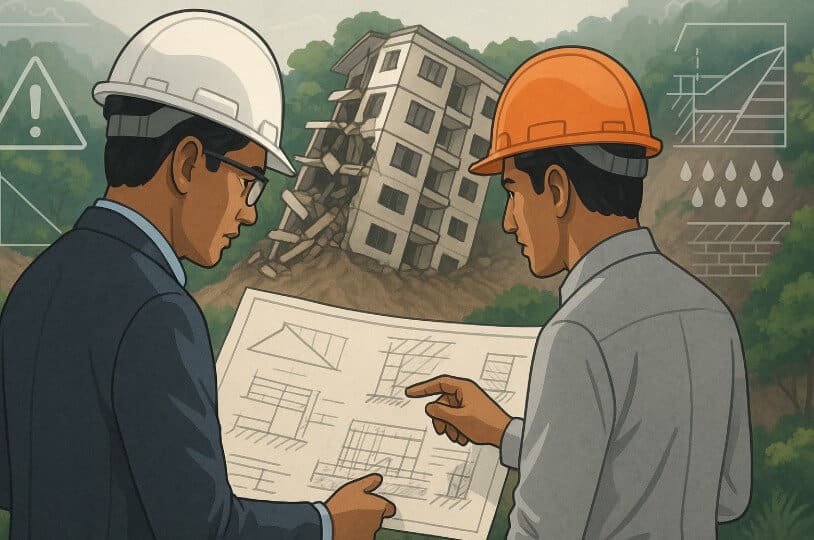
On 11 December 1993, Block 1 of Highland Towers collapsed after days of heavy rainfall and a landslide. Forty-eight lives were lost, and the country came to a standstill. Court actions and compensation dragged on for years, and the settlement figure—often cited in the tens of millions of ringgit—became shorthand for how devastating a single structural failure can be to people, property, and professional reputations.
For today’s practitioners, the Highland Towers tragedy is more than a headline from the past; it’s a living case study on why professional indemnity insurance for architect and professional indemnity insurance for engineers are essential in Malaysia—and why rigorous compliance with design standards and the Uniform Building By-Laws (UBBL) 1984 is non-negotiable.
What went wrong—and why it still matters
Accounts of Highland Towers point to multiple contributing factors: water management failures (including burst or poorly managed pipes), hillside instability, retaining wall problems, and red flags that were not adequately acted upon.
When several risk factors converge—soil saturation, weak slopes, and inadequate retaining structures—the “margin of safety” can vanish quickly. In a dense, high-rainfall environment like Klang Valley, this combination is especially unforgiving.
Why does this matter to today’s architects and engineers? Because similar risk patterns keep appearing on modern jobs: hillside developments, deep basements near existing structures, value-engineered retaining works, and late design changes driven by commercial pressures.
Even when you do not control every variable, you are expected to demonstrate reasonable skill and care: documenting your assumptions, warning clients of site risks, coordinating with specialists, and designing to accepted standards.
Negligence risk in the Malaysian context
Under Malaysian law and professional regulation, architects and engineers owe a duty of care to clients (and sometimes to others who rely on their work). Negligence claims typically hinge on four elements:
- Duty of care – A professional obligation exists.
- Breach – The professional fell below accepted standards (codes, industry practice, contract scope).
- Causation – The breach materially caused loss or damage.
- Loss – The claimant suffered measurable loss (rectification, delay, loss of rent, business interruption, personal injury, etc.).
With hillside projects, the breach may centre on inadequate geotechnical investigation, a retaining wall design that didn’t reflect groundwater realities, insufficient drainage, or coordination gaps among the architect, civil/structural engineer, and main contractor. If a failure occurs, plaintiffs will examine drawings, reports, minutes, and emails to determine who foresaw—or should have foreseen—the risk.
The UBBL and the “standard of care”
Malaysia’s UBBL sets minimum public safety and design requirements. While Highland Towers predates some modern interpretations, the principle stands: UBBL compliance is a baseline for reasonable skill and care.
Non-compliance (or failure to update a design when interpretations change) can quickly escalate into project delays, variation claims, and, in a worst-case scenario, civil actions alleging negligent design or supervision. For hillside developments, local authority guidelines, slope category requirements, and geotechnical submissions become key records in any dispute. The lesson: treat code compliance and authority engagement as design deliverables, not afterthoughts.
How professional indemnity insurance responds
Well-structured professional indemnity insurance for architect and professional indemnity insurance for engineers provides a critical financial buffer when allegations arise. While exact wording varies by insurer, quality PII commonly:
- Funds defence costs (lawyers, experts, investigations) with insurer consent.
- Pays damages or settlements if liability is established.
- Covers inquiry attendance expenses when regulators or authorities call you in (subject to sub-limits).
- Supports pre-claims assistance when you spot a circumstance early—helping contain issues before they become lawsuits.
- Includes helpful extensions such as loss of documents, defamation, intellectual property infringement, liability for consultants/subcontractors, joint-venture liability, continuous cover (for undisclosed prior matters), and run-off cover when projects complete or firms wind down.
Two points are crucial for claims-made PII: prompt notification (tell your insurer as soon as you suspect a circumstance) and no admissions without consent. Late notice or informal apologies that imply liability can prejudice cover.
A practical risk-management playbook (hillside & complex sites)
1. Start with the ground
Commission geotechnical investigations to the correct standard. Request boreholes, lab tests, permeability assessments, and groundwater monitoring appropriate to slope category and loads. If the budget is tight, document your warnings in writing.
2. Design to water, not just to soil
Many failures are hydraulic. Detail robust drainage, weep holes, subsoil drains, and inspection points. Consider long, intense storms and maintenance realities, not just “design storm” theory.
3. Record your design basis
Keep a Design Basis Report (DBR): codes used, geotechnical parameters, load cases, factors of safety, and assumptions on drainage and retaining systems. Update it as site information evolves.
4. Clarify roles in writing
Spell out who is responsible for temporary works, slope protection during construction, and third-party checks. If a specialist designs a key system (e.g., soil nails, anchored walls), define review and approval pathways unambiguously.
5. Peer-review critical elements
Request independent checks for retaining walls, deep basements, slope stabilization, and buildings in close proximity to existing structures. Document calculations and sign-offs.
6. Track authority engagement
Maintain a clean trail of minutes, submissions, and clarifications with local authorities. If code interpretations shift, issue updated advice to the client and revise drawings promptly.
7. Monitor construction diligently
Site inspections should align with your scope—but when you see something unsafe, escalate in writing. Record non-conformances and insist on method statements for risky works (excavation near footings, surcharge loading on slopes, temporary cut faces).
8. Right-size your PII
Match limits and aggregates to project value, risk profile (especially hillside/slope), and potential downstream losses (rectification + delay + reputational harm). Discuss automatic extensions (loss of documents, defamation, new subsidiaries) and run-off provisions with your broker.
Why reputational defence matters
In a catastrophic event, the public narrative can form quickly. Quality PII wordings sometimes include public relations expenses to help manage communications, ensuring facts are shared responsibly while legal positions are protected. For professionals whose names appear on drawings, preserving credibility with regulators, clients, and future tender panels is invaluable.
The bigger takeaway for today’s practices
Highland Towers is not just a historical tragedy; it’s a mirror held up to contemporary practice. Urban densification, climate volatility, and cost pressure mean your risk landscape is as challenging as ever.
The combination of strong technical governance (DBRs, peer review, authority trails) and robust financial protection (professional indemnity insurance for architect and professional indemnity insurance for engineers) is what turns a firm from exposed to resilient. Even with perfect diligence, disputes can arise; what matters is that you can defend your work and survive financially if an allegation sticks.
If you’d like help sizing limits, comparing policy wordings, or structuring extensions that fit hillside and complex urban work, start with Minaris Risk Management. A well-designed PII program, paired with rigorous design controls, ensures one bad day doesn’t define your practice.
Explore our range of coverages:
📞 Ready to secure your future? Contact us today.
Sources
- Astro Awani – Highland Towers tragedy overview: https://international.astroawani.com/malaysia-news/highland-towers-tragedy-27-years-heres-what-you-need-know-272672
- Wikipedia – Highland Towers collapse: https://en.wikipedia.org/wiki/Highland_Towers_collapse

Jayadarshiniy Sankar is a Senior Insurance Advisory Manager with a background in law and over 5 years of experience in professional indemnity and general insurance. She specializes in regulatory compliance and client solutions, delivering tailored coverage with prompt, results-driven support while actively educating clients through industry content and guidance.