
When businesses purchase property insurance, the focus is almost always on major perils — fire, explosion, flood, storms, or natural catastrophes.
These risks are visible. They feel dramatic.
But in practice, many of the most frequent and costly property losses do not arise from extraordinary events.
They arise from day-to-day operations.
At Minaris Risk Management, a significant number of disputed or partially paid property claims share one common feature:
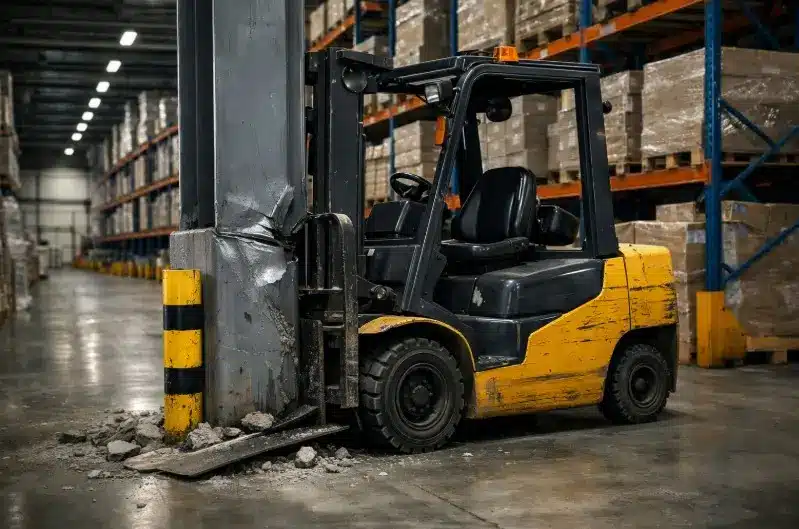
The damage was caused by the insured’s own vehicles or handling equipment — not an external peril.
The Reality on the Ground: How These Losses Actually Happen
In industrial plants, warehouses, factories, and logistics centres, internal movement never stops.
Forklifts move pallets all day.
Cranes swing loads overhead.
Stackers navigate tight aisles.
Materials are lifted, shifted, stored, and retrieved continuously.
Losses often occur in seconds:
- A forklift misjudges a turn and hits a support column
- A crane boom damages roofing during lifting
- A stacker collides with racking, causing a domino collapse
- Goods slip, fall, and damage machinery or structures below
These incidents are operational, not accidental in the traditional insurance sense — and this distinction matters.
Why Many Property Claims Are Rejected
Under standard Property / Fire Insurance policies, damage caused by:
- The insured’s own road or rail vehicles
- Forklifts, cranes, stackers, or handling equipment
- Articles dropped during lifting or internal transport
is not automatically covered.
This exclusion exists because property policies are designed to respond to external fortuitous events, not risks arising from normal business operations.
As a result, businesses are often shocked to discover:
- The damage occurred on their own premises
- The asset was insured
- The incident was accidental
…and yet the claim is repudiated.
The Clause That Makes the Difference
This exposure is addressed through a specific extension commonly known as:
“Impact Damage by Insured’s Own Vehicles & Handling Equipment” Clause
This clause is not decorative.
It is foundational for operational-heavy premises.
What This Clause Is Designed to Cover
When properly incorporated, this extension typically provides cover for:
✔ Accidental impact damage to insured buildings, plant, machinery, and contents
✔ Damage occurring during internal movement and handling
✔ Loss arising from articles dropped while lifting, loading, or transporting
✔ Operational mishaps that are not linked to fire or natural perils
This is particularly critical for:
- Manufacturing plants
- Warehouses & distribution centres
- Logistics hubs
- Cold storage facilities
- Industrial yards
- Construction-adjacent operations
What This Clause Does Not Replace (A Common Misunderstanding)
At Minaris, we always clarify limitations upfront — because misunderstandings here lead to claim disputes.
This clause:
✘ Does not replace Motor Insurance
✘ Does not replace Contractor’s Machinery Insurance
✘ Does not cover third-party liability automatically
✘ Applies only to insured property, not everything on site
✘ Is usually subject to specific sub-limits and deductibles
This is why simply “adding the clause” without reviewing limits, conditions, and operations is not enough.
The Operational Impact of a Missing Clause
When this extension is absent, a single incident can escalate rapidly:
- Structural repairs
• Machinery damage
• Production stoppage
• Delayed deliveries
• Business interruption losses
• Cash flow strain
• Disputed or rejected claims
What begins as a minor operational error can become a multi-layer financial problem.
Why This Risk Is Often Overlooked
This gap exists because:
- Many policies are renewed annually without operational review
- Brokers focus on headline perils rather than workflow risks
- Businesses assume “internal accidents” are naturally covered
- The exclusion wording is buried deep in policy conditions
Insurance paperwork may remain unchanged — while operations evolve significantly.
Minaris Risk Insight
In our experience, the most dangerous insurance gaps are not created by rare catastrophes.
They are created by:
- Familiar routines
- Daily movements
- Normal operations that feel “too ordinary to be uninsured”
At Minaris Risk Management, we approach property insurance differently.
We:
- Review how your premises actually operate
- Identify internal movement exposures
- Structure extensions based on operational reality
- Explain limitations clearly — before claims arise
Because effective insurance is not about buying more cover.
It’s about buying the right cover, in the right places.
Final Thought
If your business relies on forklifts, cranes, stackers, or internal transport —
and your property policy has not been reviewed beyond fire and flood —
You may already be carrying a silent exposure.
That’s where expert risk review makes all the difference.
Speak to Minaris Risk Management
If you are reviewing your Professional Indemnity Insurance or Top-Up PII limits, our specialist team is ready to assist.

Lim Sing Yue is an Insurance Advisory Manager with a Bachelor Degree of Business Administration (HONS) and strong expertise in client servicing, sales operations, and strategic account management. With experience in multinational firms across the electronics and procurement sectors, she excels in delivering tailored insurance solutions with efficiency and precision.