
Maritime training sits under a level of regulatory scrutiny that few other training sectors face. Every certificate a Malaysian maritime training centre issues feeds into a seafarer’s legal right to work on board a vessel, under standards set by international convention and enforced domestically by the Marine Department Malaysia.
That combination of international compliance, physical safety training, and certification responsibility creates a professional risk profile that a generic training-provider insurance policy rarely captures well.
Why Maritime Training Providers Face Distinct Professional Risk
Most corporate training providers risk a dissatisfied client or a disputed invoice. A maritime training centre or seafarer institute risks something more consequential: an assessment of “competent” that later informs whether a person is fit to serve on board a vessel, often in safety-critical roles.
If the adequacy of that training or assessment is ever questioned — whether by a shipping company, a flag state, or a regulator — the institute’s professional judgement is what’s actually being tested, not just its paperwork.
The Regulatory Framework You Operate Under
Malaysia’s core maritime legislation is the Merchant Shipping Ordinance 1952, which the International Labour Organization’s NATLEX database records as the country’s foundational maritime law. Training and certification of seafarers sits within a framework shaped by three layers:
- The Marine Department Malaysia (Jabatan Laut Malaysia), which accredits maritime training institutes domestically and oversees certification of competency
- The IMO’s STCW Convention (Standards of Training, Certification and Watchkeeping for Seafarers), which Malaysia follows as an IMO member state and which sets the international benchmark your syllabus and assessments are measured against
- Related international codes such as the ISM Code, ISPS Code, and Maritime Labour Convention, which many accredited Malaysian training providers also align with
Akademi Laut Malaysia (ALAM) remains the country’s principal cadet and pre-sea training institution, operating alongside a network of privately run, Marine-Department-accredited centres delivering STCW short courses.
What Does the Policy Actually Cover?
Professional indemnity insurance for a maritime training centre responds to claims about the quality of your professional output — training delivery, assessment, and certification — rather than physical incidents on your premises. That typically includes:
- Alleged negligence in course delivery or instruction against the STCW syllabus
- Errors in competency assessment or examination
- Disputes over the certification decision itself
- Inadequate supervision during simulator or classroom-based practical assessment
- Legal defence costs, even where a complaint doesn’t ultimately succeed
- Compensation or settlement sums awarded against the institute
This sits separately from public liability insurance, which covers physical injury or property damage — relevant given how much maritime safety training genuinely happens hands-on, with live equipment, rather than behind a desk.
Most institutes are better served holding both; we’ve set out the case for carrying professional indemnity alongside public liability cover in more detail.
Where the Exposure Concentrates
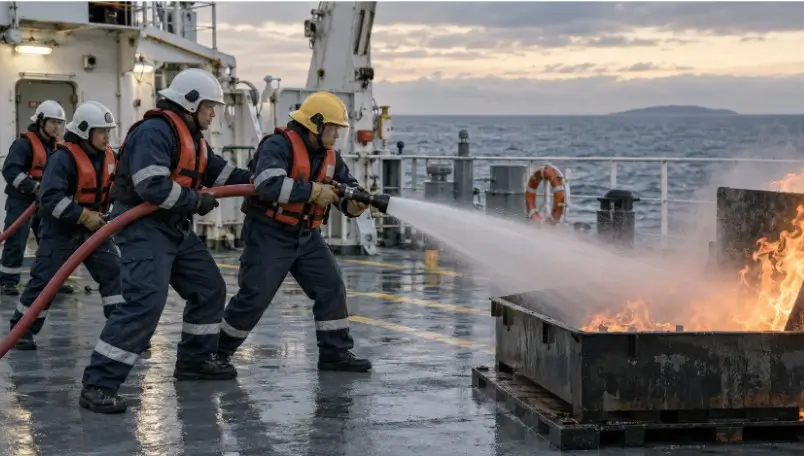
Not every course your institute runs carries equal risk. Practical, safety-critical modules — fire prevention and firefighting, personal survival techniques, elementary first aid, and personal safety and social responsibility, the standard building blocks of STCW basic safety training — involve real equipment and live drills, and the assessment outcome feeds directly into a certificate a shipping company relies on.
That’s a materially different exposure from delivering classroom theory alone, and it’s worth reflecting that distinction honestly when you’re sizing cover rather than treating all courses as the same risk.
Is Cover Mandatory for Accreditation?
Neither the Merchant Shipping Ordinance 1952 nor Marine Department accreditation itself imposes a blanket legal requirement to hold professional indemnity insurance. In practice, that’s becoming close to moot.
Shipping companies, offshore operators, and larger corporate clients increasingly run their own vendor risk assessments before awarding training contracts, and evidence of adequate liability cover is a routine part of that screening — much the way it already is for other accredited professional service providers.
For the wider argument on whether cover is worth carrying even where it isn’t strictly compulsory, see is professional indemnity insurance worth it in Malaysia.
Sizing Cover to Your Contract Value
This is the point most generic advice misses. A single bundled STCW compliance contract with a shipping line or offshore operator can represent a disproportionately large share of a training centre’s annual revenue compared with a typical professional services firm’s client relationships.
A limit of indemnity set against a generic small-business benchmark can leave a serious gap if your largest single contract — or a claim arising from it — exceeds that limit.
Who actually needs professional indemnity insurance in Malaysia is a useful starting point, but a maritime training institute should size its limit against its largest realistic contract exposure, not an industry-average figure.
If your institute also has vessel-related or marine risk exposures beyond training delivery, it’s worth reviewing this alongside Minaris’s marine insurance classes to see where the two coverages meet.
Why the Retroactive Date Matters More Than Usual
A certificate of competency issued today can be relied upon for years before anything about it is ever questioned.
If a shipping incident occurs long after a seafarer graduated and an investigation later revisits the adequacy of their original training, the claim against the institute typically surfaces well after the course itself was delivered.
That makes the policy’s retroactive date — how far back it reaches to cover past training work, not just the current policy period — one of the more important details to check, alongside confirming legal defence costs sit outside your claim limit rather than eating into it.
Frequently Asked Questions
Not under the Merchant Shipping Ordinance 1952 or accreditation rules themselves. It’s increasingly expected by corporate and shipping-company clients as part of their own vendor risk screening.
Professional indemnity covers claims about the adequacy of instruction or assessment; physical injury during a live drill typically falls under public liability instead, which is why most institutes carry both.
Professional indemnity responds to claims about your training, assessment, or certification decisions. Public liability responds to physical injury or property damage on your premises, including during practical exercises.
It should, but confirm this explicitly with your insurer — certification and assessment are core exposures for a maritime training institute and shouldn’t be assumed to be automatically included.
Against your largest realistic single contract or claim exposure, not a generic industry-average limit, given how concentrated maritime training revenue can be around a small number of large clients.
Get Cover Sized to Your Actual Contracts
Generic training-provider policies are rarely built with STCW certification risk or contract concentration in mind. Get a free, no-obligation quote from Minaris, or contact our team to talk through a limit of indemnity that reflects your accreditation scope and your largest client contracts.
This article is provided for general information purposes only and does not constitute insurance or legal advice. Coverage is subject to the policy wordings, schedule, limits, conditions, exclusions, and endorsements of the insurer.

KH Chew is the Founder and Risk Advisor of Minaris, with over 30 years of experience in the insurance industry. He holds a Diploma in Insurance from the Malaysian Insurance Institute (MII), which laid the foundation for his in-depth expertise in property, financial lines, and other general insurance products. He is widely recognized for developing tailored insurance schemes for professionals and businesses across Malaysia. KH is also a passionate advocate for risk management and regularly advises clients and trade associations on comprehensive coverage strategies.